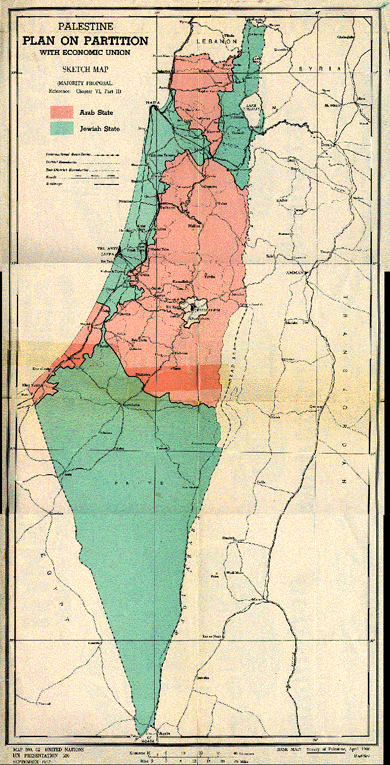
• Great Britain announces that it will terminate the mandate on 15 May, several months before the time envisioned in the partition plan. With the increasing British disengagement, the Zionist movement moves to establish control over more territory. Bordering Arab states make it clear that they will intervene.
1948: The Deir Yassin massacre takes place on 9 April, as combined Itzel and Stern gang units mount a deliberate and unprovoked attack on the Palestinian village of Deir Yassin on the western edge of Jerusalem. 254 Palestinians are massacred, including many women and children.
• Terror spreads among the Palestinian population, leading to a mass exodus of refugees to neighboring countries and areas of Palestine not under Jewish control. In total, approximately 750,000 Palestinians flee their homes and properties as a result of direct Jewish force, as well as psychological and military terrorism.
• A Jewish state, Israel, is proclaimed on 14 May, one day before the British Mandate expires and just before the General Assembly convenes a session passing a resolution containing a U.S. idea on the trusteeship of Palestine. The U.S. government recognizes the Jewish state, as does the Soviet Union. The Israeli Declaration of the Establishment of the State refers directly to U.N. resolution 181(II) as a basis for this establishment, at the same time pledging its intention to “cooperate with the agencies and representatives of the United Nations in implementing the resolution . . .”
• Upon the termination of the mandate, Jewish forces move to occupy further territory and cities beyond that specified by the partition resolution. Irregular forces from neighboring Arab states had already entered Palestine in the final weeks of the mandate; regular forces from these countries now cross into Palestine, resulting in the first Middle East war.
• Support of an Arab state in Palestine proves largely ineffective in the face of Israeli military superiority. Within weeks, Israel occupies most of the territory of Palestine (78%) with the exception of the area known as the “West Bank” of the Jordan River, and the “Gaza Strip”. The West Bank comes to be held by Jordan and the Gaza Strip by Egypt.
• Israel also takes control of the western part of Jerusalem, which had been allocated by the UN as a corpus separatum to be administered under a United Nations trusteeship. Israel destroys 37 of the 41 villages surrounding the western area of Jerusalem and more than 80,000 Palestinians are driven out of or flee from this western area, while the rest of Jerusalem- the eastern sector and the Holy Places, and the West Bank, comes under Jordanian administration. This de facto division of Jerusalem is formalized in the Hashemite Jordan Kingdom-Israel General Armistice of 3 April 1949.
• Count Folk Bernadette Sweden is appointed by the U.N. General Assembly to mediate and supervise the cease-fire. After establishing a temporary truce, he submits several proposals which are rejected by the two sides.
• On 17 September, Count Bernadette is assassinated by, according to the official Israeli view, the Stern gang. According to a U.N. report, his killers wore Israeli army uniforms. The report states that “the provisional government of Israel must assume full responsibility. ” The Security Council requests that the Israeli government investigate the assassination and submit a report to the Council (no report has been received).
• On 22 September, Israel adopts the “Area of Jurisdiction and Powers Ordinance”, which absorbs, de facto, almost half of the land allocated to the Arab state which were occupied by Israeli forces.
• On 29 November, Israel applies for admission into the United Nations, while in occupation of territories beyond those allocated in the partition resolution. Israel is criticized in the Security Council for its non-compliance with U.N. resolutions, and, on 17 December, its application fails, receiving 5 votes in favor, 1 against, and 5 abstentions.
• On 11 December 1948, the U.N. General Assembly passes resolution 194 (III), which establishes a Conciliation Commission, headquartered in Jerusalem, to continue the functions of the Mediator and the Truce Commission. The resolution reiterates the call for an international regime for Jerusalem and resolves that “. . . the refugees wishing to return to their homes and live at peace with their neighbors should be permitted to do so at the earliest practicable date, and that compensation should be paid for the property of those choosing not to return and for the loss or damage to property which, under principles of international law or in equity, should be made good by the Government or authorities responsible. . .”
1949: The Conciliation Commission for Palestine is established in January 1949, with France, Turkey and the U.S. as members. In April 1949, the Commission holds a conference in Lausanne, consisting of separate talks with the two sides. Two separate protocols are signed in May 1949 by the Arab states and Israel, agreeing to use the boundaries specified in the partition resolution as a “basis for discussions with the Commission.”
• On 11 May, Israel is admitted to U.N. membership. The preamble of the resolution admitting Israel refers specifically to Israel’s undertakings to implement U.N. General Assembly resolutions 181 (II) and 194 (III).
• Between February and July 1949, the acting mediator, Ralph Bunche of Norway, arranges armistice agreements between Israel on the one hand and Egypt, Jordan, Lebanon and Syria on the other.
• On 8 December 1949, the United Nations establishes the Relief and Works Agency for Palestine Refugees in the Near East (UNRWA) to assist the hundreds of thousands of Palestinian refugees living in makeshift camps in bordering countries. By providing shelter, food, health care and training to those living in camps, UNRWA proves to be crucial in preventing the exasperation of this human catastrophe.
1950: In defiance of United Nations resolutions, Israel moves its capital from Tel Aviv to the western part of Jerusalem on 23 January.
• The Israeli government adopts the Absentees’ Property Law, which is preceded by the Abandoned Areas Ordinance (1948), the Emergency Regulations Concerning the Cultivation of Waste Lands (1949), a series of laws legalizing the expropriation of Arab land and creating a de facto situation aimed at preventing the return of Palestinian refugees.
• On 24 April 1950, the West Bank is formally brought under full Jordanian control.
1951: King Abdullah of Jordan is assassinated in Jerusalem, on 20 July, by a nineteen year old Palestinian.
1952: The item “Question of Palestine” is dropped from the agenda of the U.N. General Assembly. At this stage, the entire issue of Palestine is reduced to that of a refugee problem.
1953: On 15 October, an Israeli army unit crosses the armistice line into the West Bank and attacks the village of Qibya, near Al-Khalil (Hebron), massacring 53 Palestinian civilians.
1956: President Gamal Abdel Nasser of Egypt nationalizes the Suez Canal. Britain and France, in a trilateral offensive with Israel, go to war against Egypt. On 29 October, Israel invades the Sinai, occupying the Gaza Strip and, along with Britain and France, the Suez Canal. At the request of the 1st Emergency Special Session of the U.N. General Assembly, British and French forces withdraw. Israel withdraws from most of the Egyptian territory it occupies, but maintains its occupation of Sharm al-Sheikh and the Gaza Strip.
• On 29 October, the same day that Israel attacks Egypt, Israeli forces impose a curfew on the Arab villages in Al-Muthalath (the Triangle), including on the village of Kafr Kasem. When the unaware villagers return home to Kafr Kasem, Israeli soldiers indiscriminately open fire, massacring 49 Palestinians.
• On 3 November 1956, one day before the end of the resistance in the Gaza Strip, the Israeli army commits a massacre in Khan Yunis, killing scores of palestinian men, women and children. The massacre occurs while the camp is still under curfew.
1957: On 8 March, Israel withdraws from Sharm al-Sheikh and the Gaza Strip and the U.N. Emergency Forces (UNEF), established earlier by the United Nations 1st Emergency Special Session, moves in.
1964: The Palestine Liberation Organization (PLO) is established and Mr. Ahmad Al-Shukairi is elected as the Chairman of the Executive Committee.
1965: On 1 January, the Al-‘Asifa military wing of the Fateh movement starts armed struggle against Israel. The Fateh movement had been organized underground in the mid-1950s as a Palestinian national movement.
1966: Israeli military units attack the village of Al-Samuh, to the south of Al-Khalil, causing extensive damage and large numbers of casualties.
1967: On 5 June, war breaks out in the Middle East. Prior to the war, Egypt closes the Strait of Tiran and requests the withdrawal of the UNEF. Israel, however, carries out a devastating offensive 1st strike, and within a few days, its forces occupy the rest of mandated Palestine- the West Bank, including Arab East Jerusalem, and the Gaza Strip- in addition to the Syrian Golan Heights and the Sinai Peninsula of Egypt.
• The war creates another population of Palestinian refugees as approximately 325,000 persons flee from the West Bank and the Gaza Strip to neighboring Egypt, Jordan, and Syria. Significant portions of this population are already refugees from 1948, and this new refugee population comes to be known as “displaced persons.”
• On 8 June, Israeli air force planes sink a U.S. navy electronic ship, the USS Liberty, in international waters of the Mediterranean Sea. 34 American officers are killed and 171 are wounded.
• Immediately after occupying East Jerusalem in the war, Israel destroys the entire Magharbi quarter in the walled Old City and in its place builds a large plaza for Jewish worshippers.
• The U.N. Security Council adopts resolution 237 on 14 June which, inter alia, calls upon the government of Israel to “ . . . facilitate the return of those inhabitants who have fled the areas since the outbreak of hostilities.”
• On 27 June, Israel adopts a law enabling the government to extend its laws, jurisdiction, and administration to East Jerusalem. The Israeli government also expands the municipal borders of Jerusalem to an area equivalent to ten times its original area.
• Soon after its occupation of the West Bank, Gaza Strip and East Jerusalem, Israel begins to confiscate Palestinian land and to establish Jewish settlements (housing and other infrastructure in specific locations) in all of the occupied territories, as well as to transfer parts of its population into these settlements.
• On 22 November, the Security Council adopts resolution 242 (1967), the provisions of which are meant to serve as the framework for peace in the Middle East. The resolution emphasizes “the inadmissibility of the acquisition of territory by war” and affirms that “a just and lasting peace in the Middle East” should be based on the following principles: “(i) Withdrawal of Israel armed forces from territories occupied in the recent conflict; (ii) Termination of all claims or states of belligerency and respect for and acknowledgment of the sovereignty, territorial integrity and political independence of every state in the area and their right to live in peace within secure and recognized boundaries free from any threats or acts of force.” The resolution also affirms the necessity of “achieving a just settlement of the refugee problem”.
• The U.N. Secretary-General appoints Ambassador Gunnar Jarring of Sweden as a Special Representative Mediator for the Middle East under Security Council resolution 242.
1968: In January, Fateh declares its political program calling for the establishment of a democratic state in Palestine where Arabs and Jews live together without discrimination.
• On 21 March, Israeli forces cross over the border into Jordan, attacking the Fateh bases in Al-Karameh. The Palestinian side (fida’iyyin) wages a heroic resistance and the battle becomes a turning point for the Fateh movement, which becomes the main Palestinian political force.
1968: Palestinian armed factions join the PLO. The Charter of the organization is amended at the Palestine National Council (PNC) meeting in Cairo.
1969: In February, Yasser Arafat of Fateh is chosen by the PNC as the Chairman of the Executive Committee of the PLO.
• On 21 August, Israeli arsonists set fire to Al-Aqsa Mosque in Jerusalem, causing extensive damage and destruction of the holy site. The U.N. Security Council responds with resolution 271 (1969) of 15 September, calling the act of destruction a danger to peace and security, and calling upon Israel to refrain from hindering the functions of the Supreme Muslim Council of Jerusalem, and condemning its failure to comply with U.N. resolutions.
• The Islamic world is outraged at the desecration of the Islamic holy site in Jerusalem. More than 28 leaders from Islamic countries, led by King Hassan II of Morocco, meet on 22 September in Rabat, Morocco, to discuss the situation. This meeting sets the groundwork for the establishment of the Organization of the Islamic Conference (OIC). The PLO is invited and attends as an observer (at a later stage, at the 2nd OIC conference, held in Lahore, Pakistan on 22 February 1974, Palestine, represented by the PLO, becomes a full member).
• On 9 December, the U.N. General Assembly adopts resolution 2535 (XXIV) reaffirming the inalienable rights of the people of Palestine.
1970: In June, U.S. Secretary of State William Rogers proposes a peace plan, which essentially calls for a cease-fire and provides a mechanism for the implementation of S.C. resolution 242. The initiative involves negotiations by the representatives of the parties concerned under the auspices of Amb. Gunnar Jarring. The United Arab Republic (Egypt), Jordan, and Israel accept the plan.
• In September, the Popular Front for the Liberation of Palestine (PFLP) hijacks four airplanes and lands them at Al-Mafrak airport in Jordan.
• That same month, the Jordanian army successfully wages a full-fledged military campaign to root out the Palestinian forces. Yasser Arafat leaves Jordan and the Palestinian forces leave Amman for the northern part of the country. The battle becomes known as “Black September.”
1971: Jordanian armed forces, with the help of units from the Syrian army, continue to battle Palestinian forces in the northern part of the country, leading to the end of armed Palestinian presence in Jordan. The legendary Palestinian leader Abu Ali Iyad is killed.
• Amb. Jarring presents an aide-memoire to Egypt and Israel proposing the conclusion of a peace agreement between the two states, as well as the Israeli withdrawal from Egyptian territory. Egypt accepts but Israel informs Jarring that it would not withdraw to the pre-5 June 1967 armistice lines, marking the end of both the Rogers Plan and the Jarring Mission.
1972: Jordan’s King Hussein, in a statement on 15 March, proposes a “United Arab Kingdom” composed of two parts, a Palestinian, represented by the West Bank and any other liberated territory, and a Jordanian, represented by the East Bank. The King would be the head of state.
• During the Olympics in Munich, the Palestinian Black September Group kills 9 Israeli athletes. Israel retaliates by bombing Lebanon and killing 400 civilians.
• On 16 October, Wael Zaitar, a Palestinian representative, is assassinated in Rome. The assassins are believed to be from the Israeli Mossad. This killing is followed over the years by a series of political assassinations by Israel of PLO officials in several European capitals, including Mahmoud Al Hamsharee (Paris) and, at a later stage, Atef Bseisso (Paris).
1973: On 10 April, 3 PLO leaders, Kamal Adwan, Abu Mohammad Yussef Al-Najjar, and Kamal Nasser, are assassinated in their homes in Beirut by a special Israeli military unit.
• On 6 October (coinciding with the Yom Kippur holidays), Egypt and Syria go on the offensive and attack Israeli military positions in the occupied territories in what is considered the 4th Arab-Israeli War. The Egyptian army dramatically succeeds in crossing the Suez Canal, destroying the Israeli “Bar Lev” defense line and makes advances into the Sinai. At a later stage, the Israeli army sends units across the canal into Egyptian territory.
• On 17 October, the ministers of the Arab oil producing states decide to cease oil exports to the U.S. and the Netherlands and decide to reduce oil production by 5% monthly until the withdrawal of Israeli forces.
• On 22 October, the U.N. Security Council adopts resolution 338 calling for an immediate cease-fire, for the implementation of resolution 242 in all of its parts, and for the start of negotiations between the parties concerned under appropriate auspices aimed at establishing a just and durable peace in the Middle East.
• On 21 December, the United Nations Peace Conference on the Middle East is convened by the Secretary-General and attended by Egypt, Jordan, Israel, the Soviet Union and the United States.
1974: At its 12th session in Cairo on 12 June, the PNC adopts a new political program which becomes known as the “10 Point Program,” calling for the establishment of the Palestinian Authority on any liberated part of Palestine. Several Palestinian factions form the “Rejection Front” within the PLO.
• In September, at the 29th Session of the U.N. General Assembly, the item “Question of Palestine” is again placed on the agenda upon the request of 55 member states.
• On 14 October, General Assembly resolution 3210 (XXIX) is adopted, inviting the Palestine Liberation Organization (PLO) to participate in the deliberations on the question of Palestine in plenary meetings. On 13 November, Yasser Arafat, Chairman of the Executive Committee of the PLO, becomes the first individual representing a liberation movement, not a member state of the U.N., to address the United Nations in a plenary meeting.
• On 28 October, the Arab Summit adopts a resolution recognizing the PLO as the sole legitimate representative of the Palestinian people.
• U.N. General Assembly Resolution 3236 (XXIX) is adopted on 22 November, reaffirming the inalienable rights of the Palestinian people, including the right to self-determination, the right to national independence and sovereignty, and the right to return to their homes and property. The resolution also requests the Secretary-General to establish contacts with the PLO on all matters concerning the question of Palestine.
• On that same day, the PLO is granted observer status under General Assembly resolution 3237 (XXIX), which invited the PLO to participate in the sessions and the work of the General Assembly, and of all international conferences convened under the auspices of the General Assembly and other organs of the U.N.
1975: In April, civil war erupts in Lebanon and Palestinian forces become engaged on the side of the Lebanese Patriotic Movement.
• The Committee on the Exercise of the Inalienable Rights of the Palestinian People is established on 10 November by the General Assembly, in resolution 3376 (XXX). Composed of twenty member states, the Committee is requested to recommend a program for the implementation of the rights of the Palestinian people.
• On that day, the General Assembly also adopts resolution 3379 (XXX) determining that Zionism is a form of racism.
1976: The Syrian army intervenes in Lebanon at the request of the Lebanese president, and military clashes take place between Palestinian and Syrian forces.
• In July, a split group from the PFLP group hijacks an Air France airliner and forces it to land in Entebbe, Uganda. Israel sends airborne commandos to Entebbe who conducts an attack on the hijackers, who are holding Israeli passengers hostage. A number of people are killed, including the hijackers, but the remainder of the hostages are rescued.
• After subjecting it to a long siege, the Syrian army enters the Palestinian refugee camp of Tel Al-Zaatar in Lebanon on 2 August, inflicting severe damage and causing a large number of casualties.
• The 5th Annual Summit of the Movement of Non-Aligned Countries (NAM) convenes in Columbo, Sri Lanka and accepts the PLO, which has been an observer since 1970, as a full member of the Movement.
• At its 66th session in Cairo in September, the Arab League Council accepts Palestine, represented by the PLO, as a full and equal member of the Arab League.
• In October, Israeli Foreign Minister Yigal Allon puts forward a plan based on the idea that Security Council resolution 242 (1967) does not require withdrawal to the 1949 armistice lines and that the final border should provide Israel with the “essential minimum of security.” Basically, the plan calls for retaining the area between the Jordan River to the east, and the eastern chain of mountains to the west, leaving most of the Palestinian population under Arab rule. Jerusalem would remain Israel’s capital but “a solution for the religious interests connected with it can be found.”
1977: In May, the Israeli Labor party loses national elections and the Likud party, under Menachem Begin, forms the Israeli government. The government then unleashes waves of settlement activity in what becomes Real Settler Colonialism of the territories occupied by Israel in 1967.
• On 4 October, the U.S. and the Soviet Union issue a Joint Statement on the Middle East in which both sides state that “the settlement should be comprehensive, incorporating all parties concerned and all questions.” They also affirm that “all specific questions of the settlement should be resolved , including key issues as the withdrawal of Israeli armed forces from territories occupied in the 1967 conflict; the resolution of the Palestinian question, including ensuring the legitimate rights of the Palestinian people.” Both sides also affirm their intention “to facilitate in every way, the resumption of the work of the (Geneva) Conference not later than December 1977.”
• On 21 November, Egyptian President Anwar Sadat goes to Jerusalem and addresses the Israeli parliament. Consequently, Egypt starts to become isolated in the Arab world.
1978: In January, President Jimmy Carter makes a statement in which he recognizes the Palestinian right to a homeland.
• In March, a Fateh naval commando unit attacks the Israeli coast (Dalal al-Mughrabi). In retaliation, Israel sends 30,000 soldiers into Lebanon, occupying the south of the country and causing enormous losses and causalities.
• In September, U.S. President Jimmy Carter hosts a summit between Sadat and Begin at Camp David. The two sides conclude the Camp David Accords, which consist of the “Framework for Peace in the Middle East” and the “Framework for the Conclusion of a Peace Treaty between Egypt and Israel.” There were also letters exchanged on Jerusalem, Sinai settlements, and the implementation of a comprehensive settlement. The first accord (Framework for Peace in the Middle East) states that, with regard to the West Bank and Gaza, a Palestinian self-governing authority would be elected for a transitional period not exceeding 5 years (replacing the Israeli military government). It further states that Egypt and Jordan will participate in the negotiations and that their delegations may include Palestinians from the West Bank and Gaza, or other Palestinians as mutually agreed. Not later than the third year, negotiations, which would be based on Security Council resolution 242 (1967), will take place to determine the final status of the West Bank and Gaza. It states that “solution must recognize the legitimate rights of the Palestinian people and their just requirements.”
• On 29 November, the first annual International Day of Solidarity with the Palestinian People, as designated by the U.N., is observed.
1979: On 22 March, the U.N. Security Council adopts resolution 446 (1979), which determines that the Israeli policy of establishing settlements in the Palestinian territories has no legal validity and constitutes a serious obstacle to peace. It calls upon Israel to rescind its previous measures and to desist from taking any actions that would change the legal status, geographic nature, and demographic composition of the occupied territories, including Jerusalem. The resolution also establishes a commission consisting of three Security Council members to examine the situation relating to settlements and to submit a report thereafter.
• On 26 March, a peace treaty is signed between Egypt and Israel in Washington, DC.
1980: The European Economic Community Summit adopts the Venice Declaration on 13 June. The Declaration states that “a just solution must finally be found to the Palestinian problem, which is not simply one of refugees. The Palestinian people . . . must be placed in a position . . . to exercise fully their right to self-determination.” The Declaration also calls for the association of the Palestinian people and the PLO in the negotiation of peace. With regard to Jerusalem, the Declaration states that “any unilateral initiative designed to change the status of Jerusalem is unacceptable” and “that Israeli settlements are illegal under international law.”
• On 30 July, in flagrant disregard of international opposition and international law, the Israeli Knesset adopts the Basic Law of Jerusalem, reaffirming the de facto annexation of pre-1967 Palestinian East Jerusalem, and declaring that “Jerusalem, whole and united, is the capital of Israel.”
• In response, the U.N. Security Council adopts resolution 478 (1980) of 20 August in which it “censures in the strongest terms the enactment by Israel of the ‘basic law’ on Jerusalem” and affirms that it “constitutes a violation of international law and does not affect the continued application of the Fourth Geneva Convention of 12 August 1949 in the Palestinian and other Arab territories occupied since June 1967, including Jerusalem." The resolution also “determines that all administrative measures and actions taken by Israel, the occupying Power, which have altered or purport to alter the character and the status of the Holy City of Jerusalem, and in particular, the recent ‘basic law’ on Jerusalem, are null and void and must be rescinded forthwith.” It also calls upon member states with diplomatic Missions in Jerusalem to “withdraw such Missions from the Holy City.”
1981: On 23 February, the Soviet Union proposes the Brezhnev Initiative for Peace in the Middle East, which includes an international conference under the auspices of the United Nations, with the participation of the 5 permanent members of the Security Council and all parties concerned, and which calls for the establishment of a Palestinian state.
• On 7 June, Israeli military planes destroy the Iraqi nuclear plant.
• On 17 July, Israeli jets bomb PLO structures in Beirut, killing 300 people.
• On 21 July, an informal understanding on a cease-fire is reached between the government of Israel and the PLO in the south of Lebanon, which lasts approximately one year.
• On 6 October, President Sadat of Egypt is assassinated during a military parade.
1982: On 5 June, Israel conducts large-scale air attacks on Lebanon, and on 6 June, it launches a full scale land, air and sea invasion of Lebanon. The Israeli invading army occupies the entire south of the country, causing enormous destruction and thousands of civilian casualties (by 30 June alone, more than 15,000 civilian are killed, 50% of them children under the age of 13).
• The Israeli army seals off Beirut on 13 June, placing it under siege. Israeli warships and armored units begin a summer long bombardment of West Beirut, aiming at Palestinian residential neighborhoods and refugee camps, destroying entire neighborhood and killing thousands. Palestinians forces heroically resist for 87 days.
• PLO forces begin to leave Beirut on 21 August, and Yasser Arafat, along with most of his troops, departs by ship. The PLO establishes its headquarters in Tunis, Tunisia.
• On 9 September, the Arab Summit in Fez adopts the Arab Plan for Peace, which is, with some slight changes, the initiative proposed by then Prince Fahad of Saudi Arabia on 7 August 1981. It calls for a Palestinian state with its capital in Jerusalem and calls for the U.N. Security Council to establish guarantees for peace among all the states of the region.
• The Lebanese president Bashir Gemayel is assassinated on 14 September and, on the next day, Israeli forces enter West Beirut, despite assurances given prior to the PLO’s departure, regarding the safety of Palestinian civilians living in Lebanon.
• On 15 September, Israeli forces surround the Palestinian refugee camp of Sabra and Shatilla, and on 16 September, they allow the Lebanese Phalangist units to enter the camps. Under Israeli surveillance, the Phalangist units massacre over 800 Palestinian civilians, including women and children.
• U.S. president Ronald Reagan, in a statement on 22 September, proposes what becomes known as the Reagan Initiative. The initiative proposes, as outlined in the Camp David Accords, a 5-year period of transition, beginning with free elections for a self-governing Palestinian Authority, and it calls for a freeze in settlement activity. In it, the U.S. does not support the establishment of a Palestinian state in the West Bank and Gaza Strip, nor does it support the annexation or permanent control by Israel of those territories. With regard to the Final Status, the initiative promotes the idea of a Palestinian self-government in association with Jordan and it affirms that UN Security Council resolution 242 (1967) applies to all fronts, including the West Bank and Gaza. Concerning Jerusalem, it proposes that city remains undivided but that its final status be decided through negotiations. Israel fiercely rejects the initiative.
• In September, multi-national forces arrive in West Beirut and the Israeli forces begin to pull out. The invasion and occupation result in widespread destruction and more than 30,000 casualties.
1983: Yasser Arafat clandestinely returns to northern Lebanon, where he joins his besieged forces. Fighting intensifies with Palestinian opposition groups allied with Syria, including a split faction of Fateh. After international intervention, Arafat leaves Tripoli (Lebanon), along with the Palestinian fighters.
1985: On 3 January, Israel discloses its Falasha Transfer Operation, which it had been conducting for the past 5 years, bringing Jews from Ethiopia to Israel.
• The Israeli air force bombs the PLO headquarters in Hamam al-Shat, Tunis, destroying most of the place and causing numerous casualties among Palestinians and Tunisians.
• A Palestinian-Jordanian agreement is reached, confirming the establishment of future confederation between Jordan and the Palestinian state (when established), and arranging for a joint delegation to the negotiations.
• Members of the Palestinian group PFLP hijack the Achille Lauro, an Italian cruise ship, off the Mediterranean coast of Egypt, and demand the release of Palestinian prisoners in Israel. Egyptian president Mubarak convinces the hijackers to surrender, but not before they kill a Jewish American passenger.
• In response to the Achille Lauro incident, the U.S. demands the removal of the head of the PFLP from the Executive Committee of the PLO. The PLO’s failure to respond leads to the U.S. decision to suspend dialogue with the PLO.
1987: The Palestinian Intifada (Uprising) against the Israeli occupation in the West Bank and Gaza begins on 8 December.
• The U.N. Security Council adopts resolution 605 (1987) on 22 December deploring Israeli practices violating the human rights of the Palestinian people in the occupied territories and requesting the Secretary-General to submit a report containing his recommendations on ways and means for ensuring the safety and protection of Palestinian civilians under Israeli occupation. At a later stage, the Secretary-General submits a report on the matter.
1988: On 16 January, Israel announces that the Intifada will be met with an “Iron Fist Policy” which involves severe beatings (termed the “breaking of bones”), mass arrests and detentions, deportations, home demolitions, destruction of private property, and the use of live ammunition and rubber bullets.
• On 16 February, 2 Israelis soldiers are accused of burying alive 4 Palestinians.
• On 16 April, Israel assassinates PLO leader Khalil Al-Wazir (Abu Jihad) at his home in Tunis, Tunisia.
• On 11 May, the Unified Leadership of the Intifada declares civil disobedience.
• On 31 July, King Hussein of Jordan declares the disengagement between the West Bank and Jordan. In his speech, he declares that a series of measures have been initiated “with the aim of enhancing the Palestinian national orientation, and highlighting the Palestinian identity.” The King states that “since there is a general conviction that the struggle to liberate the occupied Palestinian land could be enhanced by dismantling the legal and administrative links between the two banks, we have to fulfill our duty, and do what is required of us.”
• The International Court of Justice issues an advisory opinion at the request of the U.N. General Assembly. The crux of the opinion is against the U.S. attempts to close down the PLO Mission to the U.N. and its refusal to accept arbitration between itself and the U.N.
• The PNC convenes its 19th session and adopts, on 15 November, the Declaration of Independence of Palestine. It also adopts a political communiqué. In the declaration, there is an acceptance of General Assembly resolution 181(II) of 1947 and, in the communiqué, an acceptance of Security Council resolution 242 (1967). A large number of states recognize the Palestinian state and/or the proclamation.
• On 13 December, the General Assembly moves its session to Geneva to consider the question of Palestine after the U.S. fails to approve an entry visa for Yasser Arafat.
• At a news conference in Geneva on 14 December, Yasser Arafat accepts General Assembly resolution 181 (II) (1947) and Security Council 242 (1967), recognizes Israel’s right to exist and renounces terrorism. On the same day, the U.S. government issues a statement in which the president authorizes the State Department to enter into a substantive dialogue with PLO representatives.
• The U.N. General Assembly, on 15 December, adopts resolution 43/177 in which it acknowledges the proclamation of a state of Palestine by the PNC and decides that the designation Palestine should be used instead of PLO in the U.N. system.
• That December, Palestinians mark the 1st anniversary of the Intifada. By the end of the 1st year, 318 Palestinians are killed, 20,000 wounded, 15,000 arrested, 12,000 jailed and 34 deported.
1989: On 16 May, the Israeli government issues a Peace Initiative, based on the “Shamir Four Point Initiative”. While reaffirming the Camp David Accords, the initiative rejects a Palestinian state and rejects any negotiations with the PLO. It also rejects any change in the status of “Judea, Sumaria, and Gaza” (the West Bank and Gaza). It calls upon Arab states to renounce their belligerency, recognize Israel’s right to exist, and begin negotiations. The initiative proposes elections in the West Bank and Gaza to choose representatives for negotiations with Israel on a transitional period of self-rule, after which negotiations would be conducted on a permanent solution. It also calls upon the international community to improve the living conditions and rehabilitate the Palestine refugees.
1990: On 20 May, an Israeli opens fire at Palestinian workers in the Israeli town of Herzelyia, near Tel Aviv, killing 8. The Security Council convenes in Geneva to consider the situation after, again, the U.S. government refuses to issue an entry visa to Yasser Arafat.
• On 2 August, Iraq occupies Kuwait. The Palestinian public largely sides with Iraq’s Saddam Hussein and the Palestinian leadership’s position is understood to be in the same direction. The Arab world is polarized and split, and Palestinian relations with some Arab countries suffer. Arab institutions and the standing of the Palestinian cause in those institutions consequently weaken.
• The Israeli army kills 8 Palestinians and injures more than 150 at Al-Aqsa Mosque inside Haram Al-Sharif in Jerusalem on 8 October. The U.N. Security Council responds to the killings with resolution 672 (1990), which condemns the Israeli actions and recommends the dispatch of a fact-finding mission to investigate the circumstances surrounding the tragic events.
• In the month of December, Jewish immigration to Israel from the Soviet Union, at 187,000, reaches its highest number for one year since the establishment of Israel.
1991: PLO leader Abu Iyad (Salah Khalaf), as well as Hayil Abdul Hamid and Abu Mohammad, are assassinated in Tunisia on 15 January by a Palestinian member of the Abu Nidal group.
• On 19 January, Iraqi scud missiles hit Israel, which, at the request of the U.S., does not retaliate.
• The Gulf War erupts in the Middle East and the coalition forces, led by the U.S., oust the Iraqi forces from Kuwait. In the aftermath of the war, only about 30,000 of the approximately 400,000 Palestinians who live in Kuwait remain there. The rest return to the occupied Palestinian territories and to Jordan.
• U.S. President George Bush, in a statement on 6 March to the U.S. Congress, states that “We must do all that we can to close the gap between Israel and the Arab states, and between Israelis and Palestinians.” Further, he states that “a comprehensive peace must be grounded in United Nations Security Council resolutions 242 and 338 and the principle of territory for peace. This principle must be elaborated to provide for Israel’s security and recognition, and, at the same time, for legitimate Palestinian political rights.” At a later stage, Secretary of State James Baker undertakes continuous efforts to reach a Middle East peace deal.
• In mid-October, the U.S. issues Letters of Assurances on the Terms of the Peace Conference to the participating parties. The U.S. Letter of Assurances to the Palestinian side states that “we do not recognize Israel’s annexation of East Jerusalem or the extension of its municipal boundaries.” The letter also states that “the United States has long believed that no party should take unilateral actions that seek to predetermine issues that can only be resolved through negotiations. In this regard, the United States has opposed and will continue to oppose settlement activity in the territories occupied in 1967, which remains an obstacle to peace.”
• The U.S. and the Soviet Union issue invitations to the Madrid Peace Conference with the aim of achieving a just, lasting and comprehensive peace settlement through direct negotiations along two tracks, between Israel and the Arab states, and between Israel and the Palestinians, based on Security Council resolutions 242 and 338. Invited governments include Israel, Syria, Lebanon and Jordan. Palestinians are invited to attend as part of a joint Jordanian-Palestinian delegation. Egypt, as well as the EU, are invited as participants. The Gulf Cooperation Council is invited to send an observer, and the U.N. is also invited to send an observer. With respect to negotiations between Israel and the Palestinians, who are part of the joint Jordanian-Palestinian delegation, negotiations are to be conducted in phases, beginning with talks on an interim self-governing arrangement, which would last for 5 years. Beginning in the 3rd year, negotiations are to take place on permanent status issues on the basis of U.N. Security Council resolutions 242 (1967) and 338 (1973).
• On 30 October, the Middle East Peace Conference convenes in Madrid under the chairmanship of Presidents Bush and Gorbachev. The PLO does not participate. Members of the Palestinian delegation (chosen by the PLO) represent inhabitants of the West Bank and Gaza, without the participation of Palestinian Jerusalemites. The Arab states are represented at the level of Foreign Minister. Israel’s delegation is headed by Prime Minister Shamir and the Palestinian Delegation is headed by Dr. Haidar Abdel Shafi.
• On 16 December, the General Assembly adopts resolution 48/86, revoking the determination made by General Assembly. resolution 339 of November 1979 determining Zionism to be a form of racism and discrimination.
• By the end of the year, the Soviet Union begins to disintegrate after a series of changes in Eastern European countries. Russia, however, remains a co-sponsor of the peace process.
1992: On 17 December, Israel deports approximately 415 Palestinian civilians from the occupied Palestinian territory, mostly Islamic militants, to the south of Lebanon. The following day, the Security Council adopts resolution 799 strongly condemning the deportations and demanding their safe and immediate return.
1993: Representatives of Israel and the PLO initial an agreement in Oslo, Norway, on 20 August, which is publicly announced by the two sides on the 29th of August.
• On the 9th and 10th respectively of September 1993, PLO leader Yasser Arafat and Israeli PM Yitzhak Rabin exchange letters of mutual recognition. In his letter to Rabin, Arafat recognizes “the right of the state of Israel to exist in peace and security” and renounces “the use of terrorism and other acts of violence.” In his letter, Rabin recognizes the PLO as the representative of the Palestinian people.”
• U.S. President Bill Clinton, in response to the letter of mutual recognition, lifts the ban on U.S. contact with the PLO on 10 September.
• The PLO and Israel sign the Declaration of Principles on Interim Self-Government Arrangements (DOP) on 13 September in Washington DC, under the auspices of President Clinton. The famous handshake between Yasser Arafat and Yitzhak Rabin takes place. The DOP provides for a 5-year transitional period and the election of a Palestinian Authority. Negotiations on the final status issues, which specifically include Jerusalem, refugees, and settlements, are to begin no later than the 3rd year. The aim of the process is the implementation of Security Council resolution 242 (1967).
• In October, an International Donors Conference is held in Washington, DC to raise funds to assist the Palestinian people. At the conference, donor countries, mainly the U.S., Japan, the EU, Norway, and the Gulf States, pledge $2.3 billion in assistance over the next 5 years.
1994: An Israeli settler massacres about 30 Palestinian worshippers at Al Haram al-Ibrahimi in Al-Khalil (Hebron), on 25 February, during the holy month of Ramadan. The Security Council adopts resolution 904 (1994), condemning the massacre and calling upon the Israeli government to take measures to reign in the illegal and violent settlers.
• The PLO and Israel conclude the Agreement on the Gaza Strip and Jericho Area on 4 May.
• On 25 May, the U.N. Secretary-General appoints Ambassador Terje Larson as “U.N. Special Coordinator in the Occupied Territories.”
• On 1 July, Yasser Arafat returns to Palestine, arriving in Gaza on 12 July, where he establishes his headquarters. He is welcomed back by tens of thousands of Palestinians.
• On 29 August, the PLO and Israel sign the Agreement on the Preparatory Transfer of Powers and Responsibilities (Israel-PLO).
• The U.N. convenes a Special Commemorative Meeting on the 50th Anniversary of the United Nations in October. During the meeting, the same arrangements extended to member states are also extended to Palestine in its capacity as Observer.
• Israel and Jordan sign a Treaty of Peace on 26 October.
1995: The PLO and Israel sign the Israeli-Palestinian Interim Agreement on the West Bank and the Gaza Strip in Washington, D.C. on 28 September. This agreement supercedes previous implementation agreements.
• Israeli Prime Minister Yitzhak Rabin is assassinated on 4 November in Tel Aviv by an Israeli extremist.
1996: On 5 January, Yahya Ayyash, a leading member of the military wing of Hamas is assassinated by a rigged portable telephone in the Gaza Strip. It is believed that the Israeli security service "Shin Bet" was behind the killing.
• Palestinians hold their first free democratic elections in the West Bank and the Gaza Strip on 20 January, voting for a President, as well as a 188-member Palestinian Legislative Council. Yasser Arafat is elected president by an overwhelming majority.
• On 25 February, two suicide-bombers blow themselves up, killing 25 Israelis and injuring 77 others. One explosion takes place in West Jerusalem and the other in the southern town of Ashkelon. A statement is issued by the "Students of the Engineer" claiming responsibility.
• Two more suicide bombings occur, one in an Israeli bus in Jerusalem on 3 March, killing 19 people and injuring ten others, and another on 4 March in Tel Aviv, which kills 14 people and injures 130 others, bringing the nine-day death toll to 61. An armed wing of Hamas claims responsibility for the bombings.
• On 21 April, the Palestine National Council (PNC) holds its twenty-first session in Gaza City in Palestine for the first time since 1964, and decides by majority vote to "abrogate the provisions of the PLO Charter that are contrary to the exchanged letters between the PLO and the Government of Israel of 9 and 10 September 1993."
• On 1 May, Yasser Arafat, President of the Palestinian Authority, makes his first official visit to the U.S. and meets with President Bill Clinton at the White House.
• On 30 May, Mr. Benjamin Netanyahu defeats the incumbent Shimon Peres by a slim margin in the, Israeli elections, receiving 50.3% of the vote against 49.6% for Mr. Peres. A right wing government is formed.
• The Israeli government opens a tunnel near Al Haram Al-Sharif in the Old City in East Jerusalem on 24 September. Palestinians demonstrate against the Israeli action throughout the occupied Palestinian territory and in the ensuing days demonstrations continue and clashes take place between the Palestinian police and the Israeli soldiers, resulting in casualties on both sides. The Israeli army uses tanks and gun helicopters against both Palestinian police and civilians. The events result in the killing of 69 Palestinians, 15 Israeli soldiers and one Egyptian.
• On 28 September 1996, the Security Council adopts resolution 1073 (1996) in response to the opening of the tunnel. The resolution calls for the immediate cessation and reversal of all acts which resulted in the aggravation of the situation, and also calls for ensuring the safety and protection of the Palestinian people and for the timely implementation of the agreements reached.
1997: The Palestine Authority and the government of Israel conclude the Protocol Concerning the Redeployment in Hebron on 17 January which is accompanied by a note from the US Secretary of State, leading to the withdrawal of Israeli forces from 80% of the city. On 19 January, President Arafat visits Hebron for the first time, where he is welcomed by 60,000 Palestinians.
• In February, the Palestinian Central Bureau of Statistics releases preliminary results of the 1997 Census of population, housing and establishments. The estimate of the total population in the Palestinian territory is approximately 2.9 million persons. Of these persons, 1,869,818 are in the West Bank, including the illegally annexed Jerusalem, and 1,020,813 are in the Gaza Strip. A direct count in East Jerusalem is forcefully prevented by the Israeli occupying authorities, but through a variety of means, an estimate of about 210,209 persons living in that area was reached.
• The U.S. vetoes a Security Council draft resolution on Jerusalem, presented by the four European members of the Council, on 7 March. The resolution calls upon Israel to abandon its impending construction of a new settlement at Jabal Abu Ghneim, to the south of East Jerusalem. On 21 March, the U.S. again vetoes a Security Council resolution calling upon Israel to halt the construction at Jabal Abu Ghneim. That same day, in a Tel Aviv cafe, a suicide bomber kills himself and 3 Israelis.
• On 24-25 April, the U.N. General Assembly, in reaction to the two U.S. vetoes, convenes for the first time in 15 years an Emergency Special Session (ESS) to consider “Illegal Israeli Actions in Occupied East Jerusalem and the Rest of the Occupied Palestinian Territory”. It overwhelmingly adopts resolution ES-10/2 condemning Israel’s construction at Jabal Abu Ghneim, demanding cessation of all illegal Israeli actions, recommending collective measures, and establishing mechanisms for follow-up
• On 7 May, the U.N. Committee against Torture in Geneva summons Israel for a hearing to face charges that it violates the International Convention against Torture. The committee criticizes Israel for being the sole nation to have codified and legalized the use of torture in interrogation.
• The 5th of June marks the 30th anniversary of the June 1967 War and the Israeli occupation of the West Bank, the Gaza Strip, and East Jerusalem. The United Nations holds a solemn meeting on 9 June, organized by the Committee on the Exercise of the Inalienable Rights of the Palestinian People, to commemorate the 30th year of the occupation.
• On 15 July, the U.N. General Assembly reconvenes the 10th Emergency Special Session to consider the report of the Secretary-General on the actual in the occupied territory with regard to Jabal Abu Ghneim and to recommend the convening of a conference of the High Contracting Parties to the 4th Geneva Convention on measures to enforce the Convention in the Occupied Palestinian Territory, including Jerusalem.
1998: During a visit by President Yasser Arafat to Washington, D.C. on 22 January 1998, President Clinton states, inter alia, the following: “I also would like to take just a second to underline the principles of the peace process: mutual obligations and the concept of land for peace, so that Israelis can live in security, recognized by all their neighbors; and the Palestinians can realize their aspirations to live as a free people”.
• The Secretary-General of the U.N., H.E. Kofi Annan, visits Gaza and the West Bank from 23-25 March. The Secretary-General meets with President Arafat and with members of the PLC. He also visits a refugee camp and meets with Palestinian leaders in East Jerusalem.
• On 7 July 1998, the General Assembly adopts resolution 52/250, entitled “Participation of Palestine in the work of the United Nations,” voting overwhelmingly to upgrade Palestine’s representation at the United Nations to a unique and unprecedented level, somewhere in between the other observers on the one hand and Member States on the other. The resolution conferred upon Palestine additional rights and privileges of participation that had traditionally been exclusive to Member States.
• In September, the latest Israeli Central Bureau of Statistics census indicates that Israel’s population has reached approximately 5.9 million. Of that number, 4.7 million are Jews, approximately 230,000 of whom live in settlements in the occupied territories, and nearly 1.0 million are Israeli Arabs. It also indicates that the population of settlers in the West Bank and Gaza rose by 3%.
• The Wye River Memorandum is signed by President Arafat and Prime Minister Netanyahu and witnessed by President Clinton and King Hussein during a ceremony at the White House on 23 October. The Memorandum, reached after nearly 10 days of secluded meetings at the Wye Plantation Center in Maryland, provides steps for the long-overdue implementation of the interim agreements.
• U.S. President Bill Clinton visits Gaza and Bethlehem on 14-16 December 1998, becoming the first American president ever to visit any Palestinian territory and to deal directly with Palestinian leaders and institutions on their land. During the visit, the President makes many important statements, coming very close to recognizing the Palestinian right to self-determination. The president is accompanied by his family and by a large official delegation which includes the Secretary of State and the National Security Advisor. President Clinton addresses a meeting in Gaza which is attended by the Chairman Arafat, the speaker of the PNC, the speaker of the Palestinian Council, members of the PNC, the Central Council and the Palestinian Legislative Council, as well as by Palestinian heads of Ministries and other personalities .
|